Blog
Stop Collecting Skills. Build a Skill Stack.
The goal isn't to learn everything. It's to become good at solving problems that actually matter.
Tagged Learning, Career
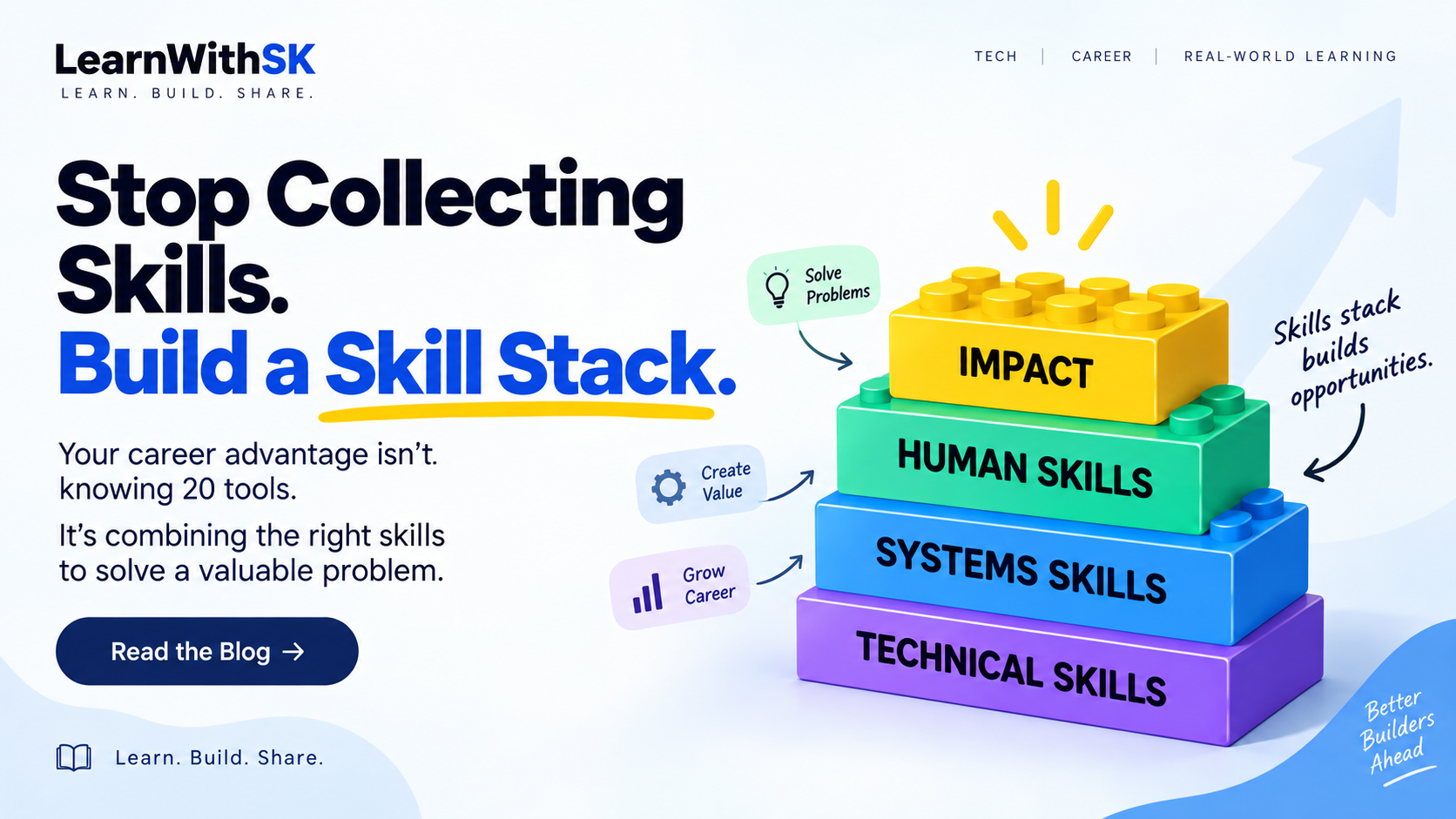
The goal isn't to learn everything. It's to become good at solving problems that actually matter.
Technology moves ridiculously fast.
One month it's a new framework. Then there's a new cloud service. Then a new AI model comes along and suddenly everyone is talking about how it is changing software development.
And if you're working in tech, it's very easy to feel like you're falling behind.
So you add things to your list.
AWS.
Docker.
Kubernetes.
Terraform.
Python.
AI.
Another certification.
Another course.
Another YouTube playlist.
The list keeps getting longer.
But here's the problem I've noticed: you can end up knowing about a lot of technologies without being particularly good at using them to solve real problems.
That's what I mean by skill collection.
I don't think the answer is to stop learning.
I think the answer is to learn with a purpose.
Instead of collecting skills, build a skill stack.
Start with the problem, not the technology
A question I see quite often is:
"What should I learn next?"
It's a reasonable question.
But I think there's a better one:
"What problem do I want to become good at solving?"
That change sounds small, but it makes a big difference.
Let's say you decide:
"I want to learn Kubernetes."
Okay. You can spend weeks learning pods, deployments, services, ingress, Helm, and everything else around Kubernetes.
But what if your actual goal is:
"I want to be able to run reliable applications in production."
Now Kubernetes is only one part of the picture.
You also need to understand:
- Linux
- networking
- containers
- cloud
- infrastructure as code
- automation
- observability
- security
- reliability
- system design
Suddenly, you're not just learning Kubernetes.
You're building the ability to operate systems.
That's a much more useful goal.
You don't need to learn everything
The technology landscape is changing quickly.
The World Economic Forum's Future of Jobs Report 2025 estimates that, on average, 39% of workers' existing skill sets will be transformed or become outdated between 2025 and 2030.
It also reports that 63% of surveyed employers see skill gaps as a major barrier to business transformation.
Those numbers can sound intimidating.
But I don't think the lesson is:
"Learn as many technologies as possible before 2030."
If anything, I think it's the opposite.
You need to become comfortable with learning and adapting.
The same report highlights analytical thinking, resilience, flexibility and agility, leadership and social influence, and creative thinking among the skills employers value highly. Technological literacy is important too.
That tells me something important.
Being valuable isn't only about technical knowledge.
It's about combining technical skills with the ability to think, communicate, adapt and actually get something useful done.
Tools change. The underlying skill doesn't have to.
Take DevOps as an example.
You could say:
"I know AWS, Kubernetes and Terraform."
That's good to know.
But I'd be more interested in hearing:
"I can automate infrastructure and deployments, improve reliability, and reduce the amount of manual operational work."
The second statement tells me much more about what you can actually do.
AWS might not be the main cloud you work with in your next job.
Terraform might not be the infrastructure tool your next company uses.
Kubernetes might not even be part of the environment.
But the underlying skills still matter.
Understanding infrastructure.
Understanding automation.
Understanding reliability.
Understanding how systems fail.
Understanding how to operate them.
Those skills travel with you.
That's why I like this idea:
Tools are replaceable. Capabilities transfer.
Don't turn your learning plan into a shopping list
I've done this myself.
You see someone talking about a technology and think:
"Maybe I should learn that too."
Then another technology comes along.
And another.
Eventually your learning plan looks something like:
AWS → Docker → Kubernetes → Terraform → Jenkins → Python → AI → ...
There is nothing wrong with any of those tools.
The problem is that there is no destination.
You're just moving from one tool to another.
A better approach is to start with something you want to be able to do.
For example:
Goal
I want to be able to build and operate reliable cloud applications.
Then you can build your stack around that goal:
Cloud
        ↓
Containers
        ↓
Kubernetes
        ↓
Automation + Infrastructure as Code
        ↓
Observability + Reliability
        ↓
Security
        ↓
AI-assisted engineering
        ↓
Business / engineering outcomes
Now the technologies have a reason to exist.
You're not learning Kubernetes because everyone says Kubernetes is important.
You're learning it because it helps you solve a particular class of problems.
That difference matters.
Being technical isn't the whole job
There's another thing I've learned over time.
Good engineering isn't just about knowing how a technology works.
You also have to think about the decisions around it.
Things like:
- What are the trade-offs?
- What happens when this fails?
- How much will it cost?
- Is it secure?
- Does it actually solve the user's problem?
- Is this more complicated than it needs to be?
- Can the team operate it?
- What happens six months from now?
You can build an impressive system and still make a bad engineering decision.
For example, maybe you design an incredibly scalable architecture.
It handles millions of requests.
Everything is automated.
The observability is fantastic.
But the application only has a few hundred users and you're spending a ridiculous amount of money to run it.
Was that really a good solution?
Probably not.
That's why I think some of the most important engineering skills aren't tied to a particular technology.
Being able to reason.
Being able to communicate.
Being able to understand trade-offs.
Being able to deal with uncertainty.
And knowing when not to build something.
The best engineers I know aren't necessarily the people who know the most tools.
They're the people who can look at a messy problem and figure out what actually needs to be done.
Don't just learn. Build something.
There's a big difference between knowing something and being able to use it.
You can finish a Kubernetes course.
You can pass a certification.
You can add Kubernetes to your resume.
But then you try to run an actual application and suddenly you're dealing with networking problems, broken deployments, bad configurations, missing metrics, security issues and unexpected costs.
That's where the real learning starts.
Real projects force you to make decisions.
And those decisions are where knowledge turns into capability.
So whenever you're learning something new, I think it's worth asking:
"What can I build that proves I understand this?"
It doesn't have to be huge.
It could be:
- a small project
- an automation script
- a deployment
- an open-source contribution
- a technical write-up
- an internal improvement
- something that saves time or money
- a measurable reliability improvement
The important part is that you have something to show for the learning.
Build proof, not just knowledge.
Try this for the next 30 days
You don't need to completely rethink your career.
Try something simple.
1. Pick one target
Choose a role or problem you actually care about.
For example:
"I want to become capable of designing and operating production-grade cloud systems."
That's much better than:
"I want to learn five new technologies."
2. Look at real job descriptions
Find around 10 jobs that are close to where you want to go.
Look for patterns.
Which skills keep appearing?
Which responsibilities keep coming up?
3. Look beyond the tool names
Don't just write down:
"Kubernetes."
"Terraform."
"AWS."
Try to understand the capability behind them.
Maybe it's:
- infrastructure automation
- container orchestration
- cloud architecture
- reliability
- security
- observability
That's the level you want to think at.
4. Pick your biggest gaps
You probably have a long list.
Ignore most of it for now.
Pick the two or three gaps that would make the biggest difference.
Then focus.
5. Build something
Don't spend the entire month watching tutorials.
Build.
Break things.
Fix them.
Document what you learned.
If possible, measure the result.
That's how you turn a skill into something you can actually demonstrate.
6. Tell the story
Once you've built something useful, update your resume, portfolio or profile.
Don't just say:
"Kubernetes — Intermediate"
Tell people what you actually did.
For example:
"Built and automated deployment of a containerized application on Kubernetes, added monitoring and health checks, and documented the recovery process."
That's a much stronger signal.
So what should you learn next?
Honestly, I don't think there's one universal answer.
It depends on where you're trying to go.
That's why I'd stop asking:
"What technology should I learn next?"
and start asking:
"What valuable problem do I want to become capable of solving?"
Then work backwards.
Problem
        ↓
Capabilities needed
        ↓
Skills needed
        ↓
Tools that support those skills
        ↓
Project that proves them
        ↓
Outcome
That approach has a nice side effect.
You don't have to panic every time a new technology appears.
You can ask:
Does this help me solve the problems I'm trying to solve?
If yes, learn it.
If not, maybe it can wait.
The advantage isn't knowing the most tools
I don't think the goal of a tech career should be:
"I know more technologies than everyone else."
Technology changes too quickly for that to be a sustainable advantage anyway.
A better goal is:
"I can combine the right skills to solve problems that matter."
That's much more valuable.
And much harder to replace.
Final thought
You don't need to know everything.
You don't even need to know every new tool that gets released.
You need to become someone who can reliably solve increasingly valuable problems.
So the next time you see a new technology and feel that familiar pressure to add it to your learning list, stop for a second.
Ask:
What problem will this help me solve?
If you don't have a good answer, maybe you don't need another skill right now.
Maybe you need a better target.
Learn something.
Build something.
Share what you learned.
Then do it again.
Learn. Build. Share.
— LearnWithSK