
Learning path / 02
Cloud Foundations
Your milestone: Design its cloud boundary
Design MicroBank cloud operating boundaries, identity, networks, data recovery, messaging, cost, and deployment readiness.
 AWS
 PostgreSQL
 Docker
Before you begin
- Complete Systems Foundations or demonstrate equivalent process, runtime, network, access, and storage knowledge.
- Use account-free designs first; later cloud checks require an approved sandbox, scoped identity, cost boundaries, and cleanup.
Your learning progress
0 of 8 available items completed
Back up or restore this path
Progress and notes stay in this browser. A backup contains only this learning path.
The learning sequence
Explore a module to see its bites and proposed checkpoint.
01Cloud engineering for the applicationTurn a working local contract into an explicit cloud operating design.Available
- Map the cloud operating boundaryLearning bite
- Give each workload scoped accessLearning bite
- Trace cloud network boundariesLearning bite
- Choose a compute operating contractLearning bite
- Design data recovery before cutoverLearning bite
- Keep the messaging contract explicitLearning bite
- Account for resources and costLearning bite
- Review the cloud handoffLearning bite
Produce a source-backed cloud readiness record covering responsibility, identity, network paths, data recovery, messaging, resource ownership, and unresolved checks.
How to demonstrate this checkpoint
- Show the prediction and the actual observation, with the selected environment or fixture label.
- Meet the stated checkpoint above and retain the verification you used.
- Try the variation in the module’s lesson evidence guide; explain the difference.
- Repeat the original check after any recovery and name remaining unknowns.
MicroBank in this path
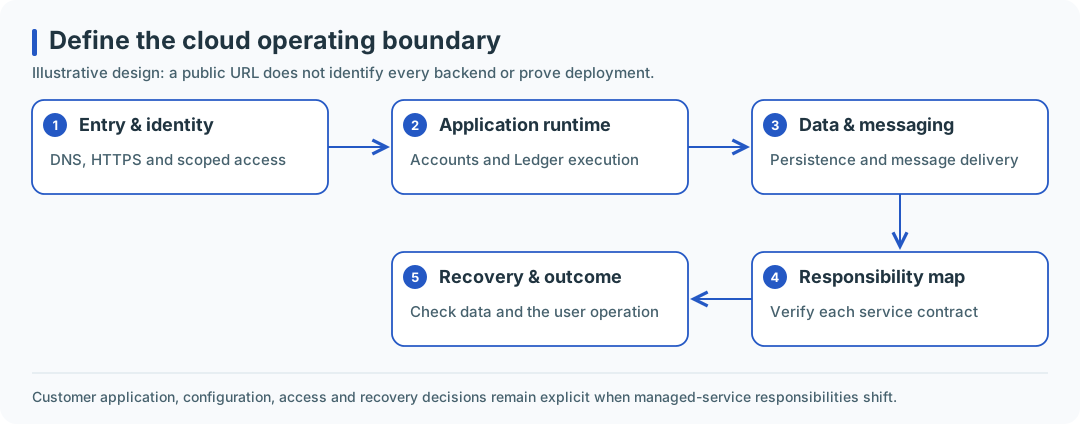
Illustrative design: a public URL does not identify every backend or prove deployment. Customer application, configuration, access and recovery decisions remain explicit when managed-service responsibilities shift.
Open the diagram at full size.
Start with a working local contract
A running MicroBank stack is not a prerequisite here. Start with its source-derived component and dependency map; DevOps Foundations supplies the later implementation milestone.
Begin with Systems Foundations. Inspect the MicroBank request and dependency map; you do not need a running full stack for these account-free design exercises. This path establishes cloud identity, networking, responsibility, and recovery concepts before the automation and application implementation in DevOps Foundations.
Follow the same MicroBank application. The selected implementation reference is versioned; newer branches may have different features and operating evidence. Record that version before drawing conclusions from a historical gap.
Build the cloud handoff
Work through responsibility, identity, networking, compute, recovery, messaging, resource lifecycle, and readiness. Each design bite asks for an explicit decision or observation. Prices, sizing, savings, availability, and recovery measurements remain unknown until supported by the selected environment.
The first checkpoint needs no cloud account. Real cloud execution remains a separate exercise with scoped authorization and actual evidence. A local emulator, rendered overlay, or site build does not prove cloud deployment.
Continue into repeatable delivery
Continue to DevOps Foundations for containers, Terraform, Ansible, Python automation, CI/CD, and the local MicroBank implementation. Production DevOps & SRE follows that working delivery baseline. The connected journey explains how the six study paths fit together.
Repository ownership
MicroBank↗ owns application code and its application tests. Ship Boring Lab↗ is the selected home for infrastructure as code, configuration management, bootstrap, GitOps, and Backstage configuration: infra/terraform/, infra/ansible/, and gitops/.
Keep ownership explicit. Terraform manages infrastructure resources; Ansible manages host configuration and bootstrap; the selected GitOps controller owns the handed-over Kubernetes desired state. Ansible and GitOps must not continually reconcile the same object. Record the actual repository revision and verification before describing a capability as implemented.
The existing infra/study examples in the pinned MicroBank guides are an isolated course fixture. They remain reproducible reference exercises, not a second authoritative owner for the operating platform. Adopt the relevant configuration into Ship Boring Lab deliberately, with separate state and a reviewed ownership handoff.